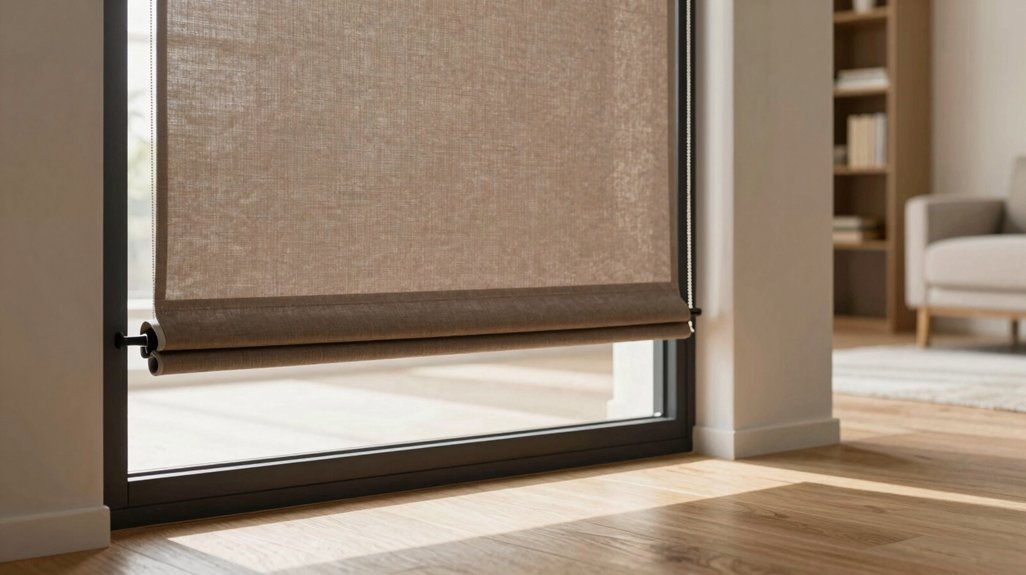
Window shade malfunctions account for 23% of annual household maintenance requests, yet most operational failures stem from improper user technique rather than mechanical defect. You’ll need to master five distinct procedural stages to guarantee shade performance and longevity.
The first step demands precise identification of your mechanism type: corded, cord-lock, cordless, mini blind, or motorized systems each require divergent handling protocols.
Position yourself squarely before the window aperture, maintaining 18–24 inches of clearance for unimpeded arm movement.
Grip the bottom rail at its lateral extremities using bilateral hand placement; this distributes tensile load evenly across the rail’s 1.5-inch standard depth.
Lower the shade at 4–6 inches per second, monitoring for lateral drift exceeding 0.25 inches.
You’ll know the locking mechanism has engaged when you detect tactile resistance at 2–3 pounds of pull force or hear the characteristic click of pawl engagement in cordless variants.
When shades resist descent, inspect cord pathways for 180-degree pinches or debris accumulation exceeding 1/16 inch before reattempting operation.
What Kind of Shade Are You Working With?
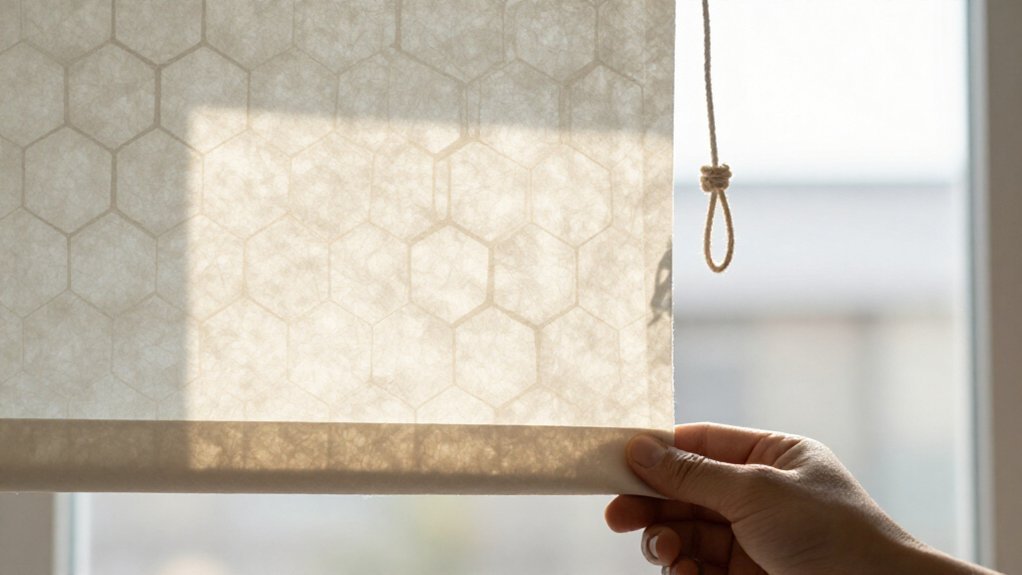
Before you attempt any manipulation of your window covering, you must first categorize the specific mechanism installed. Your blinds use one of several distinct operational systems, each demanding specific closure protocols.
Identify your blind’s mechanism first—each system requires its own specific closure method.
Mechanism Classification
- Roller Shades: Employ a spring-loaded or motorized tube; you’ll lower these using a continuous loop chain, cordless spring tension, or automated command.
- Cellular Shades & Pull-Down Blinds: Feature top-down/bottom-up configurations with cord locks or cordless lift systems; identify your locking mechanism before operation.
- Mini Blinds: Utilize tilt wands and lift cords; closing requires dual action: lowering the headrail and adjusting the slats.
- Cordless Blinds: Raise and lower via bottom rail manipulation; tilt the slats by twisting the rail itself.
- Motorized Blinds: Integrate remote, wall switch, or app-controlled lift and tilt functions.
Adjusting the slats completes closure for all horizontal systems.
Recommended Products

Compatibility: These cordless shade handles fits onto the bottom rail of some new (made since 2015) graber or bali cordless honeycomb/cellular shades

The bungee tie down conversion kit is used to modify Universal Outdoor indoor Roller Shades that have an exposed bottom rail

【Linen Fabrics】Made from high-quality linen fabric, our light filtering shades are designed to be soft and skin-friendly, transparent to light, opaque to sight. Perfect for creating a cozy and peaceful atmosphere in any room. The fabric is precisely cut with a laser without any rough edges. Linen fabric is predominantly made from natural linen fibers, which are completely natural and odor-free, providing you a more comfortable and enjoyable environment.
Position Yourself and Grip the Bottom Rail

Once you’ve identified your shade’s operational system, you’re ready to carry out the closure sequence.
Position yourself to guarantee proper mechanical alignment. Stand directly in front of the window so your motion pulls the shade straight down, not at an angle that can twist the headrail or snag the ladder or cords. This vertical orientation maintains cord integrity and helps prevent early fabric wear.
Grip the bottom rail with both hands for maximum control. This stops bending the slats of your blinds or damaging fabric panels. For cordless systems, place your hands along the bottom edge, maintaining even pressure across the width. If you are pulling the cord systems, don’t activate tilt mechanisms yet; first secure the bottom bar to lower your blinds to the desired position. This staged approach lets you lift or lower the assembly smoothly, ensuring you can open and close the shade without operational interference.
Recommended Products

【Top Down Bottom Up Cellular Shades】 Sunfree top down bottom up cellular blinds are tested for lifting and pulling down before they are delivered to the customer, ensuring that each shade can be pulled easily and smoothly. Three types of opening and closing are available to meet the needs for light, and privacy. The honeycomb shades are suitable for living rooms, bedrooms, and offices.

Inside Mount ONLY. For better internal installation, a standard 3/8 inch deduction is made to the shade width. The actual blind size is 34 5/8" W x 64" H, the unique spring rod can extend 1 inch in total, allow the blind to fit for window width 34.7-35.6 inch. (Pls Note) Minimum 1 1/5" depth of window frame required for inside mount.

Perfect Fit Guarantee: A standard 3/8 inch deduction is made to the width for a proper fit. The actual blind size will be 45 5/8"W X 64"H, perfect for window 46"W x 64"H. The spring rod adjusts up to 1" for extra flexibility, fitting windows from 45.7" to 46.6"W X 64"H.
Lower the Shade in a Smooth, Controlled Motion

Although you’ve established your stance and secured your grip, the descent itself demands equal precision to preserve mechanism integrity and fabric alignment.
Execute the Lowering Sequence
First, release the lift mechanism per your shade’s specifications. Then pull the cord to initiate descent, but don’t release tension abruptly. Instead, lower the shade in a controlled motion, releasing slack incrementally as the fabric unrolls. Maintain a gentle pull throughout; this prevents sudden drops that misalign vanes or damage the roller tube.
Guide downward with consistent pressure against the bottom rail. If your system features dual-function controls, complete the height adjustment before you adjust the tilt. Stop at the desired height, hold steady for two to three seconds until the mechanism locks in place, then return the cord to its resting position.
Recommended Products

Braided shade lift blinds cord: 1.4 mm width, 109 yards/100 meters a roll; The maximum weight it can resist is 54 kg (120 lb), please use it in the bearing limits

High quality material: the shutter curtain thread lock is made of plastic and metal, durable, not easy to break or deform, smooth surface, no scratch, not easy to break or deform, can be used for a long time.

0.9mm Ultra-Thin Diameter, 100 Yards Length – Designed for applications requiring thin, flexible control cord, not thick rope.
Lock or Set the Tension at Your Desired Height
Every shade system demands a specific final action to secure your height selection, and precision at this stage prevents drift, slippage, or mechanism fatigue. You’re now ready to lock or set the tension at your desired height.
Cord-Lock Systems (Blinds with a Cord)
Pull the bottom rail to your target position while maintaining steady cord tension. Once positioned, simply twist or pull the cord toward the locking side of the headrail until you feel the mechanism engage. Release gently; the pawl should catch and hold.
Cordless Tension Mechanisms
Grasp the bottom rail firmly. Pull down to lower, then release once you’ve achieved the desired height. The internal spring assembly locks automatically; no additional action required.
Troubleshooting
If the shade descends after release, inspect for pinched cords in the headrail before forcing any component. Proper technique extends operational lifespan.
Recommended Products

Makes Retrofitting Blinds Easy: SwitchBot Blind Tilt removes the need to replace existing louvers, and with simple installation, you can make your blinds smart instantly. (Compatible Blinds: Only supports horizontal blinds with a tilt rod. Not compatible with vertical blinds, roller shades, or roller blinds.)

1.★Touch control: Sensitively touch control, easy to get the indication. The Glass Panel touch screen is with high quality and ingenuity design, low power consumption and long service life.

4-Wire Switch Control: Includes wired switch for manual override (Up/Stop/Down), perfect for home setups or local control
What to Do When Your Shade Won’t Lower?
A shade that refuses to descend frustrates operation and signals mechanical interference, tension failure, or user-technique mismatch.
A stuck shade signals mechanical interference, tension failure, or user-technique mismatch—diagnose before forcing a fix.
First, identify your shade type: corded, cord-lock, cordless, continuous-cord/rod, or motorized. The fix depends on whether the problem is height locking, a tension spring, or power/connection.
Cord-lock shades: Check for a pinched cord in the headrail. Gently press or pull the cord toward the center while it’s held parallel to the headrail to release the lock.
Cordless shades: Grasp the bottom rail only and try a smooth pull-down. If your pleated blinds won’t lower, the tension mechanism in the headrail is likely damaged.
Corded/ladder systems: Pull to open first, typically tugging the cord to the right at a 45° angle, then release slack slowly while holding the cord position so the shade descends evenly.
Motorized shades: Confirm power, charge, or battery status, then try a remote reset.
Recommended Products

Range of Applications: white blind replacement wand is of good workmanship, it is smooth on the surface, and the hooks can easily be applied to Most kinds of windows, such as cordless blinds, honeycomb blinds and rolled shades.
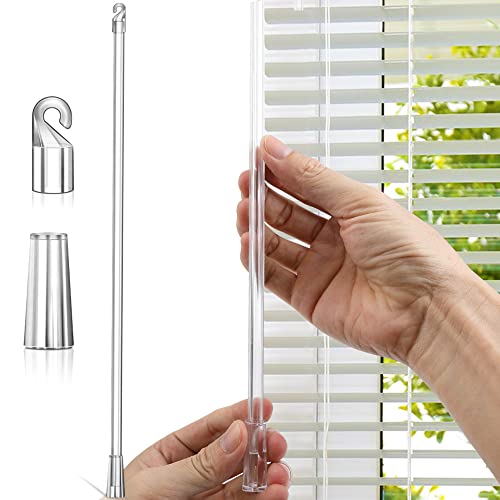
✅【PACKAGE INCLUDE】: You will receive 1 blind wand replacement with hook (including 1 Blind Openers, 1 Handles, and 1 Hooks), enough to use at home and replace your broken window blind tilt wand.

Enough quantities: you will receive 4 pieces of wand tilters in total, which can be installed into the headrail, meeting your daily replacement needs
Leave a Reply