
Stand facing your window treatment system. Identify your blind type: corded, cordless, top-down/bottom-up, or motorized. Each configuration demands distinct operational protocols.
Step-by-Step Closure Protocol
Release the cord lock mechanism or engage the bottom rail. Lower to your specified drop length, typically 36 to 72 inches for standard windows.
Tilt slats downward toward the exterior at 45-degree angles for best privacy. Verify cord tension and rail alignment.
Surface-by-Surface Comparison
| Blind Type | Primary Action | Secondary Adjustment |
|---|---|---|
| Corded | Unfasten, release cords | Retract to cleat |
| Cordless | Depress bottom rail | Adjust tilt wand |
| Motorized | Activate remote command | Program stop position |
Three critical errors—improper cord locking, reversed slat orientation, and incomplete descent—compromise both privacy and mechanism longevity.
The consequences extend beyond aesthetics.
Close Corded Blinds: Release, Lower, and Lock
To close corded blinds, you’ll first need to disengage the cord lock that holds the slats in position. Stand directly in front of the blinds and gather the cords. Pull them slightly toward the center at approximately a 45° angle to release the locking mechanism. This action frees the cord lock, permitting the bottom bar to descend.
While you lower the blinds, release tension gradually so the slats descend evenly without snagging. Let the cord slide through your fingers to maintain alignment. If one side drops faster, raise the blinds fully and lower again while keeping the cords even.
Check for tangled cords or knots in the headrail that impede operation.
When the slats reach your desired height, return the cords to their normal vertical position, typically to the right, to re-engage the lock. Should the mechanism resist, gently apply light pressure toward the center until it releases. Never force the system.
Recommended Products

High quality material: the shutter curtain thread lock is made of plastic and metal, durable, not easy to break or deform, smooth surface, no scratch, not easy to break or deform, can be used for a long time.

Notice: before order,please kindly check the size and shaped on the picture and compared with your existing lock in your blinds.because the similar ones will not fit.

4 roman shade cord locks, enough quantity to meet your daily need, fitting for blinds, roman shades and similar window treatments; They are applied to easily open and close the shade by gripping and releasing the cords.
Close Cordless Blinds: Pull Down and Tilt
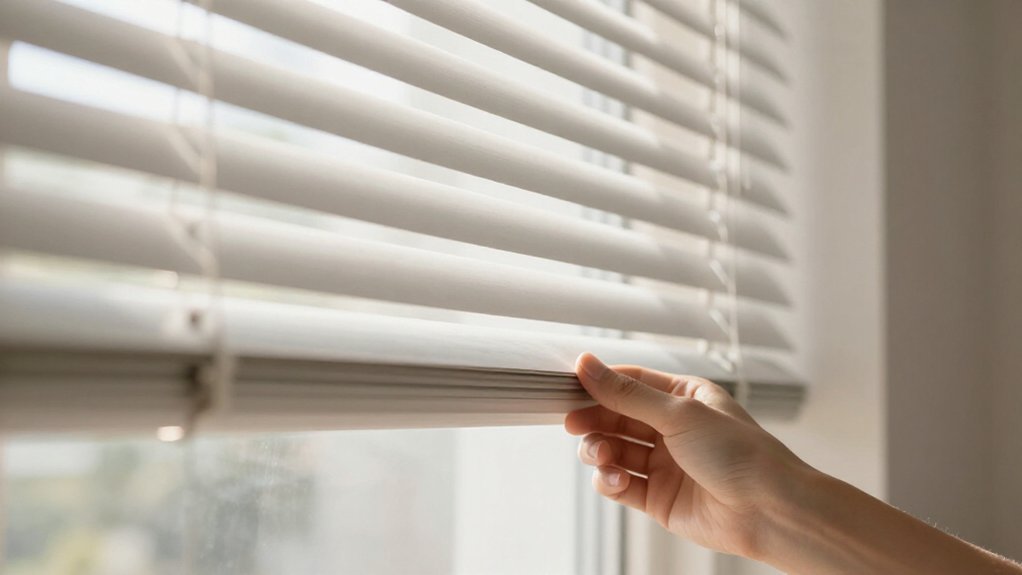
Because cordless blinds operate without external lift cords, you’ll manipulate the bottom rail directly to achieve complete closure. Pull the bottom rail downward with both hands spaced evenly, lowering it smoothly without dropping to your desired position.
Pull the bottom rail downward with both hands to lower cordless blinds smoothly to your desired position.
Adjusting the Slats
For precise light and privacy control, tilt the slats using either the tilt wand or by angling the bottom rail itself. Tilt the slats toward the center of the window to block sightlines; angle them downward for enhanced privacy. Make small adjustments, as minor angle changes greatly affect visibility.
Maintenance
Make certain you keep tilt mechanisms clean. Wipe the wand, bottom rail, and headrail regularly to prevent dust accumulation that causes stiffness. Clean mechanisms ensure consistent, reliable slat positioning for best performance.
Recommended Products

Package of 10pcs Bottom rail cord cover button plugs

High-quality Materials: These bottom rail lock buttons are made of high-quality plastic, which is durable, lightweight, easy to carry and store, and can be reused for a long time

Package of 20pcs Bottom rail cord cover button plugs
Which Way Should Slats Face? (Up or Down for Privacy)
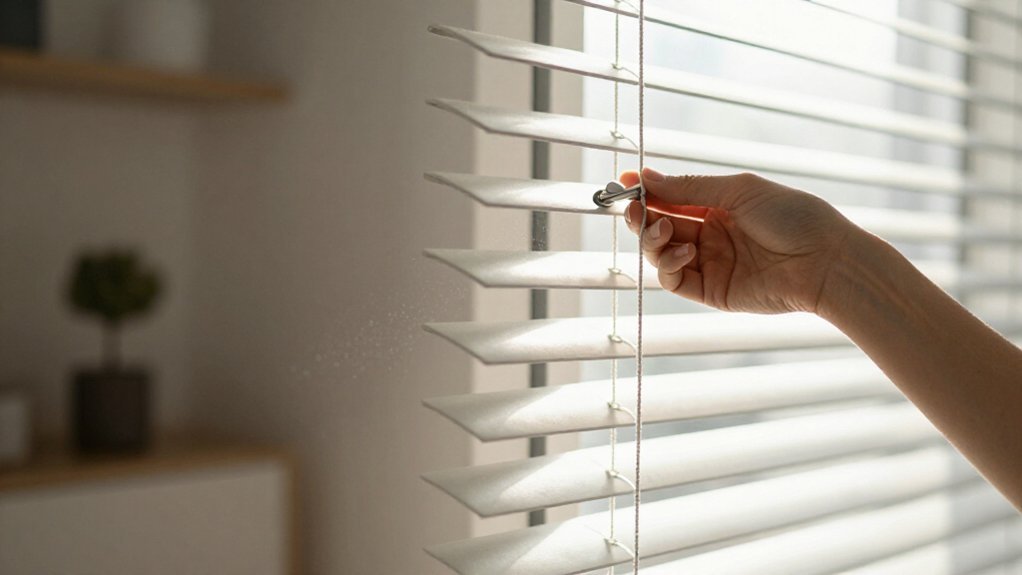
Determining ideal slat orientation requires evaluating two primary variables: time of day and your privacy priorities relative to light transmission. Understanding the mechanism matters: whether you tilt slats upward or downward shapes both illumination and concealment.
Daytime Configuration
Tilt slats so they slant down toward the window. You block glare while preserving ambient light entry.
Nighttime Configuration
Whether slats face up or down to lower them depends on your objective. For the privacy-first slat position, angle slats downward toward the room; this minimizes gaps and reduces people seeing in.
The Sightline Rule
Apply this principle: position slats to obstruct outside observers, particularly those positioned higher up looking downward. Test from outdoors after dark, then adjust the slat angle until visibility into the room drops to near zero.
Recommended Products

【Top Down Bottom Up Cellular Shades】 Sunfree top down bottom up cellular blinds are tested for lifting and pulling down before they are delivered to the customer, ensuring that each shade can be pulled easily and smoothly. Three types of opening and closing are available to meet the needs for light, and privacy. The honeycomb shades are suitable for living rooms, bedrooms, and offices.

Inside Mount ONLY. For better internal installation, a standard 3/8 inch deduction is made to the shade width. The actual blind size is 33 5/8" W x 48" H, the unique spring rod can extend 1 inch in total, allow the blind to fit for window width 33.7-34.6 inch. (Pls Note) Minimum 1 1/5" depth of window frame required for inside mount.

Inside Mount ONLY. For better internal installation, a standard 3/8 inch deduction is made to the shade width. The actual blind size is 34 5/8" W x 64" H, the unique spring rod can extend 1 inch in total, allow the blind to fit for window width 34.7-35.6 inch. (Pls Note) Minimum 1 1/5" depth of window frame required for inside mount.
Fix Pinched Cords and Stuck Mechanisms
Start by inspecting the headrail, the top housing where cords converge, for a pinched cord before you force anything; this is the most common culprit when corded blinds won’t lower. Once you’ve identified the obstruction, gently work it free.
To release a jammed cord-lock, pull the cords taut and move toward the center slightly at 45 degrees until you feel a click, then lower slowly. This angle disengages the tension mechanism without stripping internal components.
If one side drops faster, raise the blinds fully and lower again while guiding each cord evenly, keeping slats aligned throughout descent.
For cellular shades with persistent sticking, examine the entire cord path for knots, tangles, or fraying. Avoid force, it damages the lock.
When headrail mechanism issues persist beyond user-serviceable adjustments, consult a professional technician.
Recommended Products

Makes Retrofitting Blinds Easy: SwitchBot Blind Tilt removes the need to replace existing louvers, and with simple installation, you can make your blinds smart instantly. (Compatible Blinds: Only supports horizontal blinds with a tilt rod. Not compatible with vertical blinds, roller shades, or roller blinds.)

EASY INSTALL BLINDS: The remote blinds have a simple and practical no-drill mechanism(suitable for inside mount). Attach the adhesive extension block to the groove of the upper rail (it is forbidden to put more than one block), and then push it into the window frame. There is a battery compartment at the top to supply power for the shades. If the batteries are low, just take them out and replace. A stylish valance is included to block the light from the gap between fabric and the top rail

【Advanced Solar Charging Technology】: Our motorized zebra blinds are equipped with cutting-edge solar charging technology. They are powered by rechargeable batteries, which are complemented by complimentary solar panels,providing free and sustainable energy. No longer dependent on traditional electricity, ensuring a sustainable, eco-friendly and cost-effective compared to standard dry batteries. With this feature, you don't have to worry about replacing batteries or high energy consumption
Operate Top-Down and Motorized Blinds
Once you’ve resolved mechanical issues with standard corded systems, you’ll encounter increasingly common variants that demand distinct operational protocols.
Top-Down, Bottom-Up Systems
For top-down, bottom-up configurations, you’ll operate dual cord sets independently. Pull the left cord to lower or raise the top portion; this channels daylight through the upper aperture while maintaining lower privacy. Manipulate the right cord to raise or lower the bottom section, adjusting light filtration and sightline obstruction through the lower hemisphere.
For locking, draw the appropriate cord left per your model’s specifications, then release slack incrementally until you achieve target height.
Motorized Blinds
With motorized blinds, you’ll press “up” or “down” on the remote, wall switch, or smart home system interface. These automate lift functions, eliminating manual cord handling. If units fail, verify power or battery status, execute remote reset procedures, and re-establish app connectivity before escalating to manufacturer support.
Note: tilt wand operations to adjust the slats remain separate from lift mechanisms in most integrated designs.
Recommended Products

【No Drill 30s Quick Install】Install the vinyl mini window blinds in under 30 seconds with our screwless mount system—no tools no drill, and no damage to your walls….
Close Blinds at Night for Maximum Privacy
Because nighttime illumination inverts typical sightline dynamics, you’ll need to reverse your daytime tilt protocol to maintain privacy. When you close blinds at night, angle horizontal slats upward toward the window; slanting down toward the room exposes interior sightlines to observers at eye level.
Slat Tilt Technique
Grab the tilt wand or second cord. Rotate pleated slats until they slant down toward the window, blocking downward sightlines from outside. Pull two cords together to lower blinds fully, then release slack to position to lock.
Make sure the bottom rail rests at your desired height before final tilt adjustment.
Cord Management
Excess cord length invites tangling and dirt buildup. Secure cords to prevent operational interference.
Verify from outside that no gaps remain. Adjust until light blocks completely while preserving your interior window view.
Recommended Products
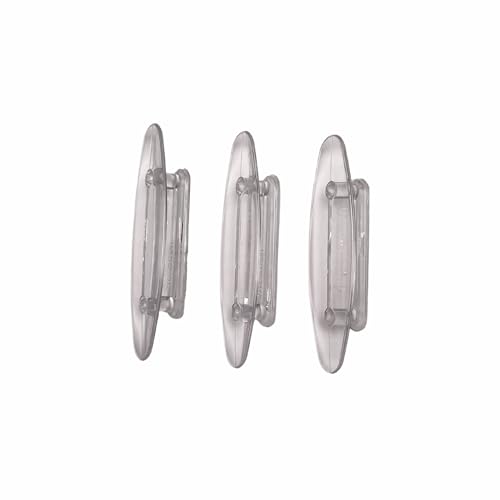
Protect Children & Pets From Dangerous Blind Cords Help keep dangling window blind cords safely wrapped and out of reach to reduce the risk of entanglement while creating a safer home for curious children and pets.

Notice: before order,please kindly check the size and shaped on the picture and compared with your existing lock in your blinds.because the similar ones will not fit.

Patented American Engineering: Proudly designed and engineered in the USA. Our patented design delivers an attractive, reliable window hardware solution that eliminates unsightly cord clutter and safety risks.
Prevent Common Closing Mistakes
You’ll avoid premature mechanism failure, suboptimal privacy coverage, and aesthetic unevenness when you recognize three critical failure modes: forcing jammed or misaligned components beyond their operational tolerance, selecting tilt angles that maximize rather than minimize sightline penetration, and permitting asymmetric cord tension that produces cascading slat misalignment.
For corded systems applying ≥5 pounds of pull force at non-specified vectors, you’re not only risking internal pawl damage but also creating strangulation hazards; data from the U.S. CPSC indicates cord-related incidents remain the leading blind-related injury category in residential settings.
Your corrective protocols vary by malfunction signature: resistance during descent warrants complete raising and controlled re-lowering with 45° vector pulls toward the centerline, persistent tilt aberrations require re-evaluation of slat orientation relative to sightlines from adjacent elevation, and reactive tension asymmetry demands inspection of headrail cord routing geometry.
Forcing Mechanisms
Although forcing a mechanism might seem like the quickest path to fully closed slats, this approach typically compounds the underlying issue rather than resolving it. When you pull the tilt wand or second cord, apply steady pressure; if slats feel stuck, stop immediately. Check the headrail for debris or misalignment before proceeding.
For blinds with a cord, position your hands slightly toward the center at approximately 45 degrees to release the cord lock. Yanking from sharp angles jams the mechanism, so guide cords through your fingers, lowering them smoothly. Avoid snapping cords into position.
If cordless systems resist operation entirely, repeated forcing damages internal tension components. Troubleshoot through gentle handling first; replacement becomes necessary only after elimination of obstruction-based causes.
Wrong Tilt Angle
Why do your blinds still expose the interior after you’ve “closed” them? You’ve likely set the wrong tilt angle. When you tilt the slats upward, you reduce visibility from outside at night; tilt them downward toward the window for daytime privacy. Don’t assume one orientation works universally: observers above your window require different positioning than those at street level.
For cord/ladder horizontal blinds, use the tilt wand or second rotation point to make incremental adjustments. A slight change dramatically alters both light transmission and sightlines. If the slats of your blinds resist staying put, reset them fully open, then close blinds gradually rather than forcing the mechanism.
Unlike fabric that rolls, standard slatted blinds come with precise tilt requirements. Pull the cord while lowering to your desired height, then adjust. Never crank the tilt mechanism beyond its engineered range; this preserves alignment and extends operational lifespan.
Uneven Lowering
Because uneven lowering ranks among the most frequent operational failures in corded horizontal blinds, you must understand its root causes before attempting remediation. Uneven lowering typically stems from imbalanced cord release or tangled mechanisms within the headrail.
To lower your blinds correctly, first find the cord and stand directly in front. Gently pull at approximately a 45° angle toward the center to release the cord lock mechanism smoothly. Avoid side-angle pulls, which disrupt cord alignment and worsen uneven lowering.
Simply pull to release, then tension slowly while keeping the cords pulled evenly with consistent force across all string ladders. Lower slowly, guiding slats during descent.
If one side descends faster, raise fully and repeat lowering. Should cords become pinched or tangled, move the cord back to free the obstruction. For multi-string configurations, adjust your blinds by operating all strings uniformly; each ladder controls its distinct section, demanding coordinated operation to maintain horizontal alignment.
Leave a Reply