
You’ve encountered three distinct window treatment mechanisms, each demanding precise manipulation. Cord-lock systems require 45-degree angular traction; cordless variants utilize bottom-rail gravitational deployment; motorized units depend on signal transmission protocols.
Your specific hardware configuration determines operational success. The consequences of improper technique range from mechanism degradation to complete functional failure.
What distinguishes a smooth descent from a tangled malfunction?
Identify Your Blind Control Type in Seconds
Before you attempt any adjustment, you must first determine which control mechanism your window treatment employs, as each system demands a distinct operational protocol.
Before adjusting your blinds, always identify the control mechanism—each system requires a specific operational approach.
Cord-Lock Systems
You’ll recognize cord-lock cords by their single or paired pull cords descending from the headrail. These older mechanisms control both height adjustment and slat tilt through cord manipulation.
Cordless Mechanisms
Cordless blinds eliminate visible cords entirely. You grasp the bottom rail to raise or lower, while a wand typically tilts the slats.
Motorized Units
Motorized blinds feature a remote, wall switch, or app interface. Most motorized systems control slat tilt only, often via directional arrows.
Vertical Configurations
Vertical blinds utilize side-to-side panels. You’ll operate these through either a cord draw loop or a baton attached to the leading panel.
Multi-String Arrangements
When encountering three-string systems, treat them as an integrated set. Pull left and release to permit and lower the blind.
Recommended Products

High quality material: the shutter curtain thread lock is made of plastic and metal, durable, not easy to break or deform, smooth surface, no scratch, not easy to break or deform, can be used for a long time.

VERSATILE CORD COMPATIBILITY: Accommodates up to three professional lift cords, suitable for 1.4mm, 1.6mm, 1.8mm, 2.0mm, and 2.2mm string sizes.
Pull Down Cord-Lock and Cordless Blinds
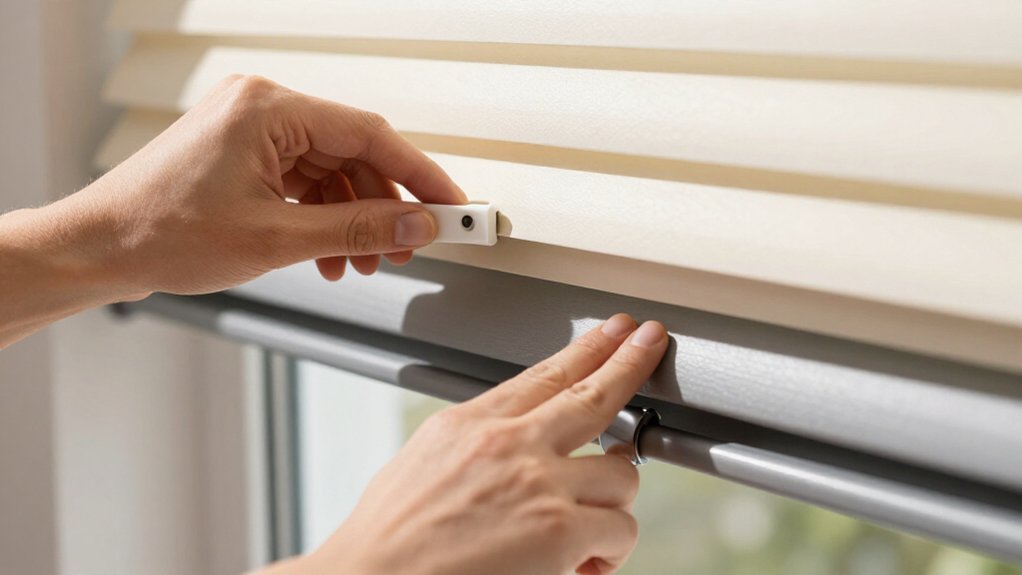
Once you’ve identified your control mechanism, you’re ready to execute the lowering procedure with precision.
Cord-Lock Blinds
For cord-lock blinds, stand in front and gently pull the cord toward the center at approximately a 45-degree angle. This releases the locking mechanism. Lower the blinds by feeding cord through your hand until the bottom bar reaches your desired height.
Avoid yanking; internal clutches can jam.
Cordless Blinds
For cordless blinds, grasp the bottom rail with both hands, never the slats. Pull down to lower, push up to raise. The internal tension mechanism maintains position without additional locking.
To adjust the slats, twist the tilt wand gradually; minor movements appreciably alter light filtration and privacy levels.
| System | Control Method | Critical Action |
|---|---|---|
| Cord-lock | Cord at 45° angle | Gentle, consistent pressure |
| Cordless | Bottom rail, two hands | Vertical motion only |
Recommended Products

Compatibility: These cordless shade handles fits onto the bottom rail of some new (made since 2015) graber or bali cordless honeycomb/cellular shades

Compatibility: These cordless shade handles fits onto the bottom rail of some new (made since 2015) Graber or Bali cordless honeycomb/cellular shades

Package of 10pcs Bottom rail cord cover button plugs
Troubleshoot Blinds That Won’t Lower?
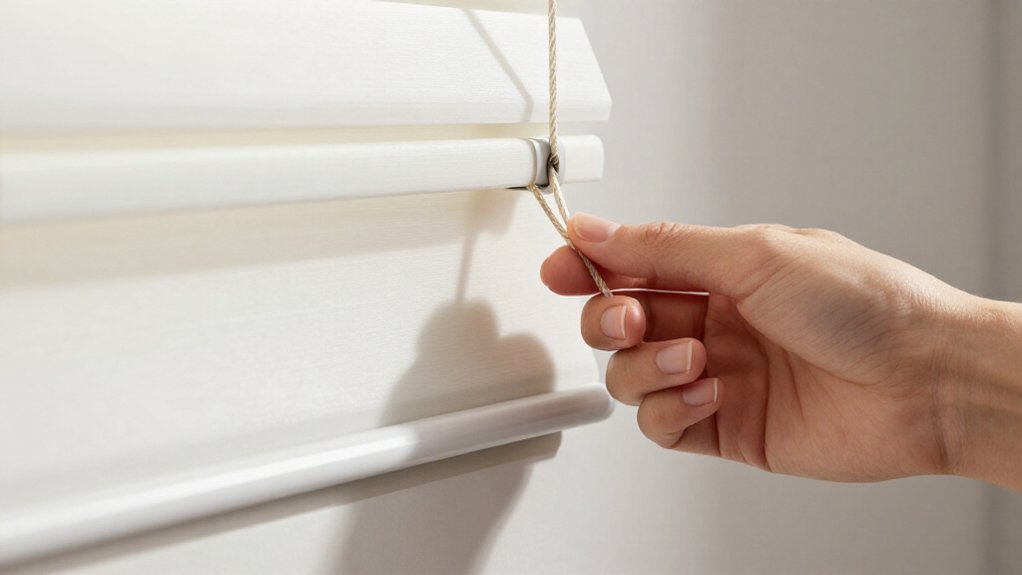
Even with correct operation, mechanical failures occur. You can resolve most issues systematically.
- For cord-lock blinds, inspect the headrail for a pinched cord. You’re pulling gently toward the center while applying light pressure until the cord releases and hangs straight.
- If lowering still fails, raise and reset fully. Forcing mechanisms worsens jams or uneven lock engagement.
- For cordless blinds, check the tension mechanism inside the headrail. Test for stiffness when moving the bottom rail; avoid yanking slats.
- Examine blind cords for fraying. The U.S. Consumer Product Safety Commission identifies strangulation hazards to young children, so stop using damaged motorized shades or corded systems immediately.
Recommended Products

Makes Retrofitting Blinds Easy: SwitchBot Blind Tilt removes the need to replace existing louvers, and with simple installation, you can make your blinds smart instantly. This pack includes 3 Blind Tilts and a SwitchBot Hub Mini, great for any home.

Excellent Blackout Effect: Our motorized blinds achieve full blackout with 4-layer fabric that blocks light, noise, provides privacy control, insulation and UV protection; Motorized roller shades perfect for bedrooms, living rooms, offices, and more

Excellent Blackout Effect: Our motorized blinds achieve full blackout with 4-layer fabric that blocks light, noise, provides privacy control, insulation and UV protection; Motorized roller shades perfect for bedrooms, living rooms, offices, and more
Leave a Reply