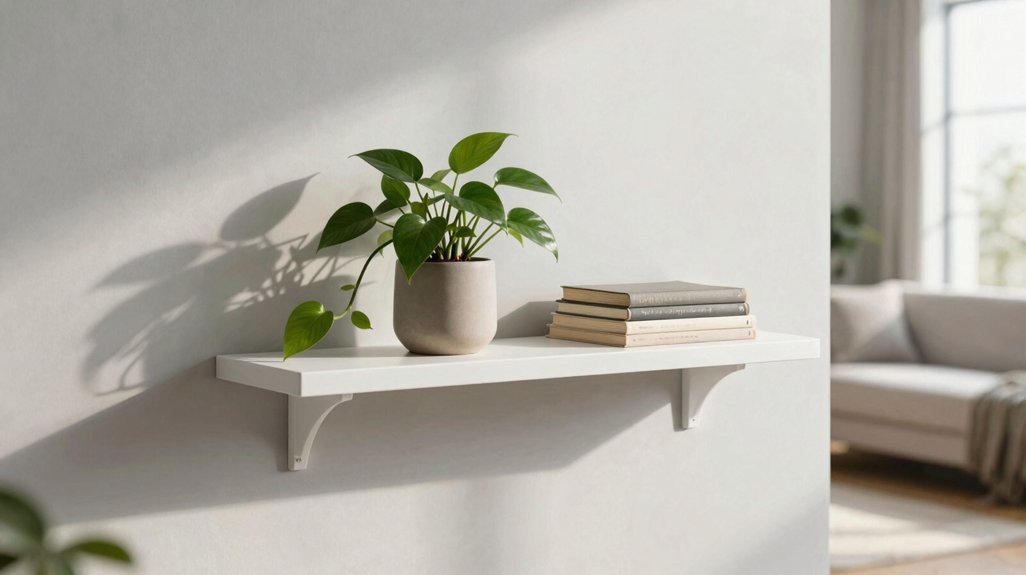
You encounter floating shelves in high-end residential and commercial installations where visual minimalism takes priority over exposed hardware.
These systems employ concealed cantilever brackets, threaded rods, or integrated wall cleats; each method demands specific substrate preparation: 5/8-inch drywall minimum, 16-inch on-center stud spacing, or embedded blocking for masonry.
Load capacities range dramatically, 15–50 pounds per bracket for hollow-core units versus 75–100+ pounds for steel-reinforced solid timber.
Your material selection, bracket gauge (typically 1/4-inch to 3/8-inch steel), and anchor type (toggle bolts, lag screws into studs, or epoxy-set threaded rod) determine whether the installation succeeds or fails catastrophically.
The following sections dissect each variable with measurable precision.
How Floating Shelves Create the “Floating” Illusion
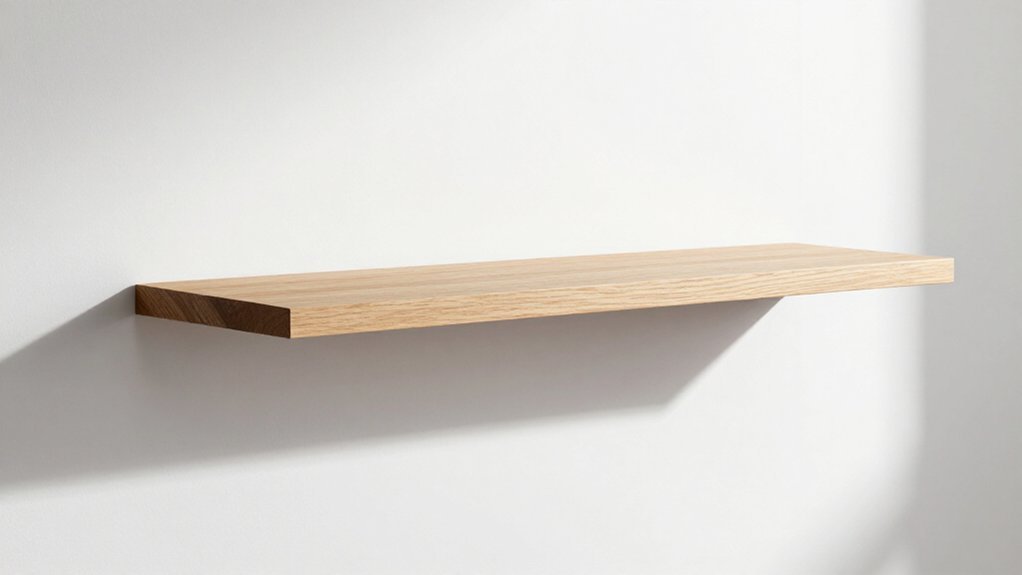
The fabrication process involves three critical stages:
Three precision stages transform raw material into seamless support: groove, engage, rotate, and conceal.
- Channel routing: A precision groove accommodates the bracket profile
- Tilt-and-lock alignment: You angle the shelf downward, engage the bracket, then rotate upward
- Set-screw fixation: A concealed fastener underneath secures the assembly flush to the wall surface
This internal mounting methodology, distinct from external L-bracket configurations, distributes approximately 45–50 lb per stud contact point. The hardware vanishes entirely from view, producing that characteristic levitation effect without sacrificing load-bearing capacity.
Recommended Products

Superior Quality: Our floating shelf bracket is expertly crafted from premium steel, ensuring exceptional durability and an impressive weight capacity of 110lbs.
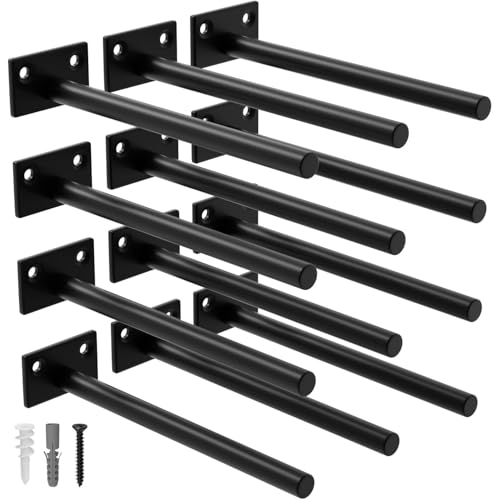
Superior Quality: Our floating shelf bracket is expertly crafted from premium steel, ensuring exceptional durability and an impressive weight capacity of 110lbs

The bracket has a 1" backplate and is designed for use with boards 1.5" thick or more.NOTE: The board thickness we refer to is the actual (not nominal) size.
Hidden Brackets vs. Visible Brackets: What’s the Difference?
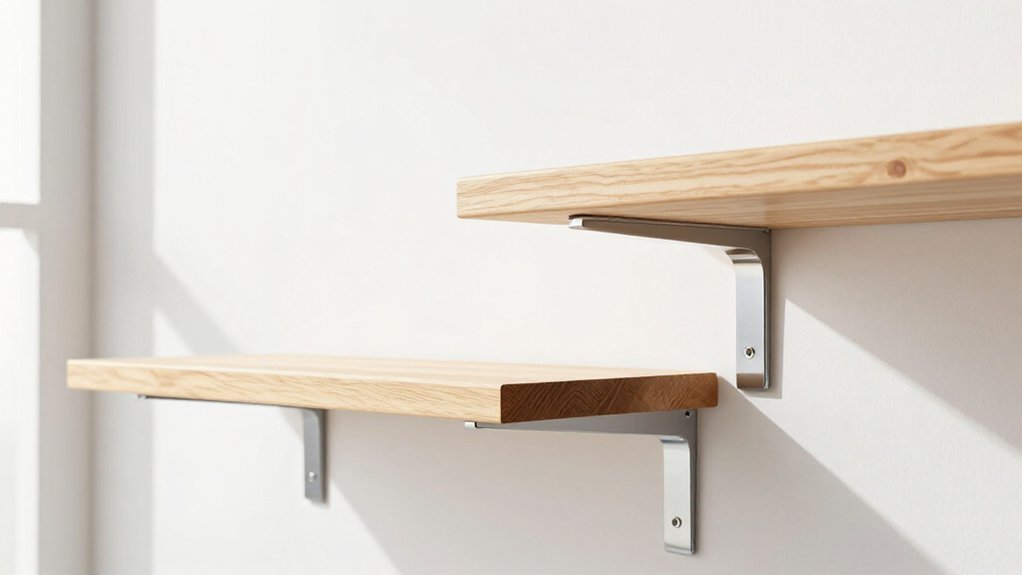
Whether you’re specifying hardware for a residential install or advising a client on shelving options, you’ll need to understand how bracket visibility fundamentally alters both aesthetics and structural performance.
Hidden Brackets vs. Visible Brackets****
Visible brackets expose L-shaped metal supports beneath the shelf, typically capping at 25–30 lb per bracket depending on fastener strength. You’ll often secure these with wall anchors when studs aren’t available.
Hidden bracket systems route a channel into the shelf’s rear, concealing hardware for clean sightlines. A stud-mounted configuration screws male brackets into studs; female brackets recess into the shelf, then a set screw locks alignment underneath. This stud connection yields roughly 90–100 lb capacity, dramatically exceeding visible brackets’ limits.
Concealed designs demand solid hardwood or heavy-duty construction, as thin materials sag despite robust hardware.
Recommended Products

【Standard 90° bending】In order to ensure that each shelf bracket can be at 90° to the maximum extent possible, we add a rigorous picking process before the shelf brackets are packaged. The standardized 90-degree design is so important that it’ s the objective factor in ensuring that items remain level and do not tip over after being placed on the board(board is not included).

Measuring 12 x 1-1/2 inches, these brackets perfectly work with a traditional 12 to 14-inch deep shelves board (Orders do not include boards)

Well-designed Floating Shelves: Our white floating shelves for wall are made of MDF Laminate. These wall shelves can organize daily sundries to tidy your space, display your art pieces on the wall to decorate your home, and make it full of aesthetic flare.
Solid Wood or Hollow Core: Which Material Lasts?
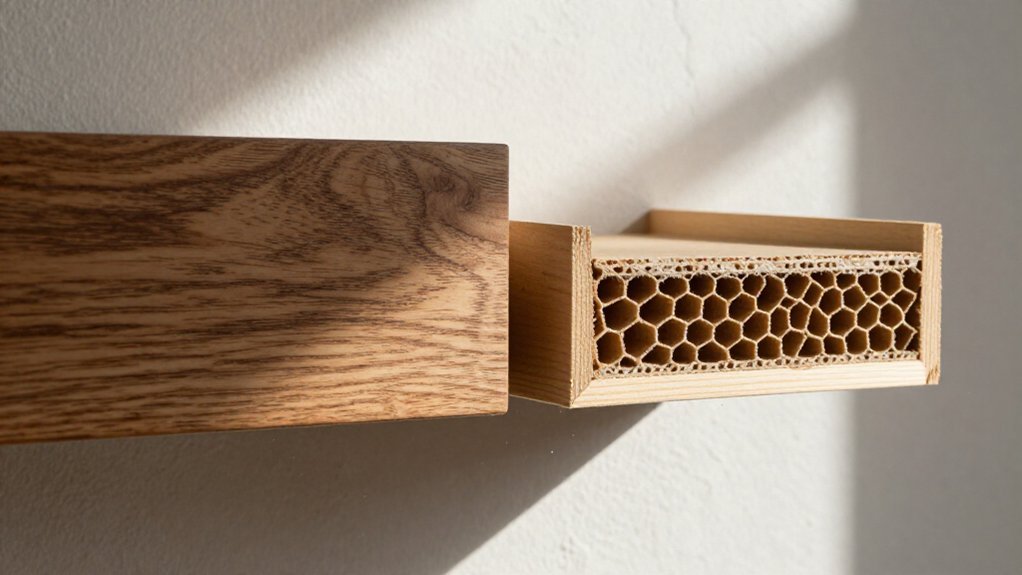
Bracket selection determines load capacity, but material composition governs long-term dimensional stability and structural integrity under cyclic loading.
Hollow-Core Construction
You’ll find these shelves lightweight and budget-friendly. They’re built from two thin MDF or particleboard faces with cardboard or plywood cores. However, you’ll watch shelves sag under heavier loads. Edges chip easily, and moisture causes swelling.
Solid Hardwood Performance
Solid wood floating shelves built from solid hardwood deliver superior stiffness and density. You’ll get better dimensional stability and markedly reduced flexing under cyclic loading. Concealed stud-mounted bracket systems typically mandate solid hardwood for reliable engagement.
Practical Specifications
You’ll commonly see hardwood at 1.8″ thickness. Greater mass equals more dependable support.
Decision Matrix
| Application | Recommended Material |
|---|---|
| Frames, small décor | Hollow-core |
| Real weight, longevity | Solid hardwood |
Choose hollow-core for light display; select solid hardwood when you demand structural permanence from concealed-bracket installations.
Recommended Products

1.57" THICK SOLID WOOD CORE & 50LBS HEAVY-DUTY ANTI-SAGGING: Our floating shelves feature a 1.57" solid wood core, distinct from hollow MDF or flimsy boards that easily bend. Reinforced with heavy-duty invisible dual-pipe iron brackets, each wall mounted floating shelf supports up to 50 lbs without bending, warping, or sagging—even under long-term daily use. Confidently store your heaviest household items, from extensive hardcover book collections to cast iron cookware and large potted plants. Built to outperform ordinary wall mounted shelves with superior load-bearing capacity, these sturdy solid wood floating shelves ensure long-lasting durability for your home storage system.

Natural Acacia Wood: Crafted from solid Acacia, these natural wood floating shelves bring warmth and durability to any space—With walnut finish, the shelf adds farmhouse wall decor charm to your kitchen or shelves for bedroom styling

1.57" THICK SOLID WOOD CORE & 50LBS HEAVY-DUTY ANTI-SAGGING: Our floating shelves feature a 1.57" solid wood core, distinct from hollow MDF or flimsy boards that easily bend. Reinforced with heavy-duty invisible dual-pipe iron brackets, each wall mounted floating shelf supports up to 50 lbs without bending, warping, or sagging—even under long-term daily use. Confidently store your heaviest household items, from extensive hardcover book collections to cast iron cookware and large potted plants. Built to outperform ordinary wall mounted shelves with superior load-bearing capacity, these sturdy solid wood floating shelves ensure long-lasting durability for your home storage system.
How Much Weight Floating Shelves Actually Hold
Against common assumptions about shelf material strength, you’re actually constrained by the concealed bracket’s torque resistance against wall studs, not by the shelf board itself.
Load Capacity by Stud Configuration
| Studs | Typical Capacity |
|---|---|
| 1 | 45–50 lb |
| 2 | 90–100 lb |
| 3 | 135–150 lb |
You’re looking at roughly 45–50 lb per stud for standard concealed shelf brackets. A two-stud floating shelf install handles 90–100 lb; heavier configurations with reinforced hardware reach ~300 lb on two studs, with large setups cited up to ~475 lb.
Critical Distinctions
Visible L-brackets typically max out at 25–30 lb, far below concealed systems. Your shelf brackets drive performance: stud-bolted concealed hardware outperforms decorative alternatives.
Material matters secondarily. Solid hardwood through-thickness shelves pair with high-rated concealed brackets; hollow-core options sag under heavier loads. You must match much weight requirements to both bracket capacity and shelf composition.
Recommended Products

[ 6mm Thick French Cleat Heavy Duty ]: 18 inches long, made by heavy duty aluminum with 6mm thick, the french cleat supports about 140 pounds max. Plastic anchors in the hardware kit make the screws fixed better in the wall, and help to provide secure and reliable hanging.

High-quality Material Made of stainless steel, a whole die-casting molding structure, rust and corrosion resistance, strong toughness, and load bearing, and can use for a long time.
What Size Floating Shelf Fits Your Space?
To get it right, you’ll need to measure your wall precisely before choosing shelf dimensions, accounting for stud spacing, adjacent fixtures, and visual proportion. Depth options run from 6 to 12 inches, lengths span 12 to 72 inches with standard increments at 36, 48, and 60 inches, and hardwood thickness typically measures 1.8 inches.
Match these specifications to your intended use: shallow depths suit accent displays, while deeper shelves accommodate storage; longer runs create feature walls, and custom sizing ensures exact wall alignment.
Recommended Products

Heavy-Duty Floating Shelf Bracket: Our heavy-duty shelves is made of high-quality nickel-plated iron, each supporting weight up to 110lbs/50kg. Sturdy and durable, not easy to rust, ensuring the life of the floating shelf.

【All-In-One PS5 Wall Mount Multifunctional Station】This upgraded wall mount integrates cooling fan, dual controller fast charger, RGB ambient lighting and headset storage hook all in one, saving massive desk space by mounting your entire PS5 console setup on the wall. Perfect fit for PS5 Slim, PS5 Pro, Original PS5 Disc and Digital versions, one mount fits all PlayStation 5 models. Built-in bubble level ensures straight, stable installation on walls.

✓ HIGH-QUALITY METAL MATERIALS: Our shelf support is made of thick and heavy duty iron materials.Features a thick black matte surface coating that delivers enhanced water resistance and effective anti‑rust performance for long‑term daily use.
Measuring Your Wall
How precisely must you measure before selecting a floating shelf? You will need to measure the wall length where installation occurs, accounting for the shelf’s full span and any desired end overhang. Standard floating shelves range from 12 to 72 inches, with common runs at 36, 48, and 60 inches. You must also measure available depth from the Wall to obstacles; typical depths span 6 to 12 inches, ensuring clearance from trim, fixtures, or doors.
Vertical clearance demands equal attention. Mark your bottom edge placement: approximately 10 to 12 inches above a couch back or 16 inches above a mattress maintains ergonomic reach and sight lines.
For load security, grab a stud finder. Locate studs, since concealed brackets require stud mounting; each stud supports roughly 45 to 50 pounds. Verify adequate stud spacing for your shelf length and anticipated load.
Choosing Shelf Dimensions
Once you’ve mapped your wall’s constraints, you’re ready to specify the shelf itself.
Depth Selection
Pick depth based on display requirements. Typical floating-shelf depths range 6–12 inches: shorter depths suit accents above doorways, while longer depths accommodate everyday items.
Length and Thickness
Choose length to match wall span and styling goals. Common lengths span 12–24 inches for small displays and 60–72 inches for feature-wall statement runs. Solid hardwood floating shelves, such as Alder Floating products, typically employ 1.8 inches of thickness for stability with concealed-bracket systems.
Vertical Spacing
Plan placement early. Living-room installations sit 10–12 inches above couch backs for eye-level viewing; bedrooms mount approximately 16 inches above mattresses for bedside access.
Load Confirmation
Confirm capacity with spacing and material. Floating shelves may arrive cut to the inch, yet stud-mounted brackets remain essential; drywall anchors alone prove insufficient for safe load-bearing.
Where to Mount Floating Shelves for Maximum Stability
You’ll achieve maximum stability only when you anchor your floating shelf’s concealed bracket into solid structural framing, not hollow drywall.
Stud Spacing Essentials: Always secure the bracket across a minimum of two studs, using a stud finder to align mounting holes precisely; this dual-stud configuration distributes torque evenly and typically supports 90–100 lbs, compared to roughly half that capacity from a single stud.
Wall Material Matters: Drywall alone cannot withstand the cantilevered load of a floating shelf, so you must locate actual wood or metal studs, or alternatively, use heavy-duty toggle bolts rated for your specific wall substrate if stud placement conflicts with your desired location.
Recommended Products

Heavy Duty design, maxium support weight of 100lb for a pair of this L bracket. Matte black powder coat finish. Creating a rustic, reclaimed, salvaged look,perfect for your home, office, garage, work space or anywhere else

Package Content: 4Pcs 4-Inch Floating Shelf Brackets, 8Pcs Strong Screws, 8Pcs Wall Plug

Sturdy & Reliable: Our 8-inch heavy duty floating shelf brackets, made from carbon steel, ensure durability and support up to 100 lbs. Ideal for kitchen shelves, fireplace mantels, and office storage.
Stud Spacing Essentials
Three fundamental variables govern floating shelf stability: bracket penetration into structural framing, stud spacing alignment, and load distribution across attachment points.
When you install floating shelves display units in your living room, you’ll need to master stud spacing essentials first. Standard stud spacing runs approximately 16 inches or 24 inches on-center. You must select shelf lengths and bracket positions that align precisely with this framing rhythm, never between studs.
Load Capacity by Stud Engagement
| Studs Captured | Approximate Load Limit |
|---|---|
| 1 stud | 45–50 lb |
| 2 studs | 90–100 lb |
| 3 studs | 135–150 lb |
If you catch only one stud, restrict loads to roughly 45–50 pounds. Heavy items increase torque and amplify sag risk. For maximum capacity, align brackets across three studs.
When framing geometry prevents multi-stud capture, install in-wall blocking between studs. This solid backing transfers bracket loads directly into structural members rather than relying on drywall anchors with comparatively limited holding power.
Wall Material Matters
Every installation decision hinges on substrate integrity. You must anchor floating shelves to wall studs whenever possible; concealed brackets screw directly into vertical framing for maximum stability and load strength. Drywall alone cannot sustain significant loads, so you’ll rely on included wall anchors only when holes miss the framing.
Stud Engagement and Load Capacity
- Two studs: 90–100 lb (standard installation)
- One stud: 45–50 lb (minimal support)
- Three studs: 135–150 lb (heavy-duty capacity)
For the strongest mounting, add in-wall blocking between studs. You should also match shelf material to your mounting plan. Solid hardwood, such as white oak, provides superior stiffness and dimensional stability for concealed-bracket systems. Hollow-core shelves sag more readily under heavier weights.
Plan your bracket placement carefully; alignment with multiple studs turns a decorative display into a structurally sound storage solution.
Installing Floating Shelves That Won’t Sag or Fall
For floating shelves that remain level and secure under load, proper installation hinges on concealed bracket systems anchored directly into wall studs.
Stud-Mounted Bracket Systems
You’ll fasten each bracket into at least two studs, achieving 90–100 lb capacity; three studs yield 135–150 lb. Miss the framing, and you’ll compromise structural integrity entirely.
Placement Specifications
Position living-room shelves 10–12 inches above couch backs, bedroom shelves 16 inches above mattress tops. Proper height minimizes leverage stress and maintains ergonomic access.
Material Selection
Choose solid hardwood for stiffness; hollow-core MDF or particleboard flexes, swells, and chips under load. For Thick Floating applications or Open shelving that’s made to order, specify hardwood cores to prevent deflection.
Mounting Protocol
Drill carefully, align precisely, and deploy wall anchors only as fallback. For maximum loads, install in-wall blocking between studs.
Recommended Products

Rounded Edges & Fully Coated: Crostice accessories shelf designed with rounded edges and a fully coated surface for safe usage; ideal for homes with children or pets; thickened metal plate construction enhances longevity; protected by US Design Patent

YOUR ITEMS, YOUR WOOD – YOU SUPPLY IT: Supply 3/4" thick wood (e.g., 1×4 to 1×10 pine or plywood, sold separately) for custom-fit shelves that match your items.

Elevate your Space – Transform any room with our heavy duty wall shelf brackets. Our brass shelf brackets are the perfect blend of size and strength for everyday shelving needs. These L-shaped shelf brackets support floating shelves, book shelf brackets, closet shelves and farmhouse shelving in kitchens, garages, and bathrooms.
Why Floating Shelves Fail (and How to Prevent It)
Even with proper bracket selection and stud mounting, floating shelves can still fail when installation protocols are compromised or material specifications are ignored.
Critical Failure Points
You compromise load-bearing integrity when you anchor concealed brackets solely into drywall anchors rather than two or more wall studs, which catastrophically reduces real weight capacity. Hollow-core construction, MDF or particleboard with cardboard cores, invites sagging, edge-chipping, and moisture-induced swelling that loosens connections. Incorrect tilt-and-lock alignment before set-screw tightening creates uneven load transfer and gradual deformation.
Overload Risks
You exceed safe limits when you ignore stud-rated capacities: approximately 45–50 lb per stud, yielding 90–100 lb across two studs or 135–150 lb across three. Heavy items amplify torque at the wall plate.
Prevention Protocol
You prevent collapse by selecting solid hardwood or engineered systems, securing to studs or blocking in any room in the house, and periodically inspecting hardware under sustained loads.
Recommended Products

Unique L-shaped Design: The L-shaped acrylic floating shelf features a distinctive design that adds a touch of elegance to any space. It provides a modern and minimalist look while showcasing your items

1.57" THICK SOLID WOOD CORE & 50LBS HEAVY-DUTY ANTI-SAGGING: Our floating shelves feature a 1.57" solid wood core, distinct from hollow MDF or flimsy boards that easily bend. Reinforced with heavy-duty invisible dual-pipe iron brackets, each wall mounted floating shelf supports up to 50 lbs without bending, warping, or sagging—even under long-term daily use. Confidently store your heaviest household items, from extensive hardcover book collections to cast iron cookware and large potted plants. Built to outperform ordinary wall mounted shelves with superior load-bearing capacity, these sturdy solid wood floating shelves ensure long-lasting durability for your home storage system.

Wall-mountable floating shelf easily installs without needing a single tool—just place, push, slide, and hang.
Best Uses for Floating Shelves Throughout Your Home
Across residential applications, floating shelves function as space-optimizing architectural elements when you match their mounting configuration, material specification, and dimensional proportion to each zone’s functional demands and structural constraints.
Living Rooms: Mount long shelves 10–12 inches above the couch back. You’ll keep decor at eye level without crowding the seating area.
Bathrooms: Install a single shelf above the toilet. It holds towels, candles, and small plants while maintaining spatial openness.
Kitchens: Position shelves above counters for dishes, mugs, cookbooks, and spices. You gain display functionality plus grab-and-go access.
Bedrooms: Mount shelves 16 inches above the mattress. They replace nightstands for phones, water, and reading lights while preserving floor space.
Laundry Room: Use stud-mounted shelves over machines. These shelves hold detergent jugs and daily loads within reach, eliminating clutter.
Recommended Products

[𝐅𝐫𝐞𝐧𝐜𝐡 𝐜𝐥𝐞𝐚𝐭 𝐰𝐢𝐭𝐡 𝐕𝐞𝐫𝐬𝐚𝐭𝐢𝐥𝐞 𝐌𝐨𝐮𝐧𝐭𝐢𝐧𝐠 𝐎𝐩𝐭𝐢𝐨𝐧𝐬]:Our 18 Inch 2 Pair French Cleat Picture Hanger provides a flexible solution for various applications, from hanging art to whiteboards and cabinets.


Function:This french cleat hanger wall mounting bracket hardware kit includes all of the tools for a quick and easy installation. Z hanging kit is designed with Z shapes, can make your picture frame firmly fit with the wall without leaving redundant holes; you’ll have all you need to begin hanging your memories throughout home
Leave a Reply